Just like with "Married Life" (in my previous post), this clip uses no dialogue, just very evocative music. There is also no color in the film (except for a bit of red). Despite this, it received an Academy Award for Best Animated Short Film. I think it is the story - again, not a very unusual or imaginative plot, but a very simple, ordinary plot told in an imaginative way - coupled with the music, that makes this film so engaging. Perhaps, when music is meant to play a large role in a film, simple stories are best, because the viewer is able to concentrate on the effect of the music-visual story instead of concentrating on what the story is actually about . . . . At any rate, it does make sense that vocals are limited, which would definitely cut into the music's momentum.
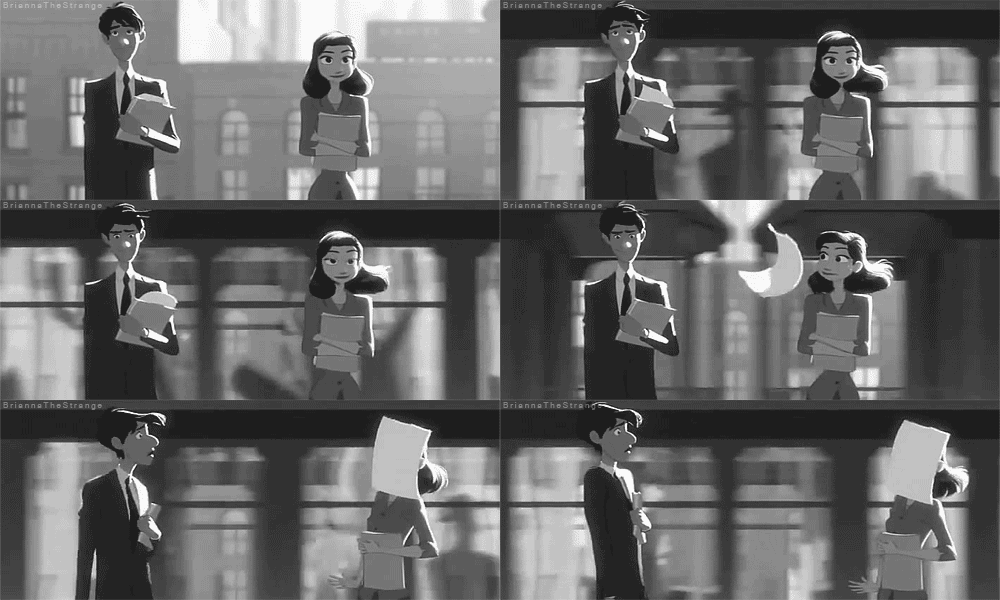 |
| From "Paperman" |
A second short film, "La Luna" (2012) by Pixar, has more dialogue, and the music is a little muted compared to "Paperman" and "Married Life" - it's more of a complement to the breathtaking visuals than a storytelling mechanism. Here is the clip, with only a weirdness at the end with the credits: https://www.youtube.com/watch?v=xaibXFC-KhI. "La Luna" is not necessarily a complex story, but it's definitely not a universal or ordinary one - a boy and his father and grandfather sweeping stars off the Moon. In this case, an extraordinary story is told simply; in the cases of "Married Life" and "Paperman," however, ordinary stories (a marriage, falling in love) that have been told and lived trillions of times are told in an extraordinary way.
Each of the stories, told in different styles but with a concentration on the visual-musical relationship, evoke different feelings in the viewer; "La Luna" has the most obvious moral and is perhaps the most simplistic story, but it is still enjoyable to watch. "Married Life" and "Paperman" are a little more complex, with less of a lesson and more of an exploration about the human condition. They are also the least "safe" - there is more sadness in them, and they are more realistic - there is, perhaps, a greater chance of becoming moved or changed upon watching them. In that sense, it is more dangerous to experience that kind of story - yet, in the end, it is also more fulfilling.
 |
| From "La Luna" |

No comments:
Post a Comment